
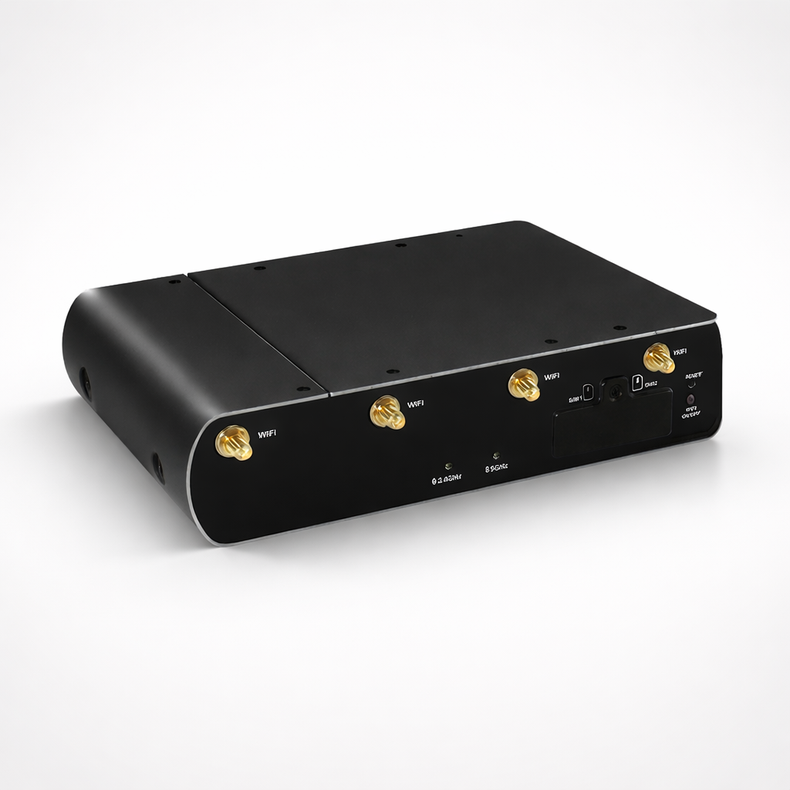
Enterprise-Grade Connectivity Built for Resilience and Performance:
As cellular networks continue to evolve, enterprise and industrial deployments demand more than raw throughput. Reliability, redundancy, RF performance, and long-term stability are now baseline requirements. The BEC M600 Series was designed specifically for these environments, combining advanced 5G NR, LTE-Advanced Pro, routing intelligence, and ruggedized hardware into a single platform engineered for always-on connectivity.
Developed by BEC Technologies, the M600 Series is purpose-built for applications where uptime, carrier flexibility, and deterministic performance matter. When paired with properly engineered antenna and cabling systems, it becomes a scalable foundation for enterprise, transportation, and mission-critical networks.
Built for Availability and Network Resilience:
Network resilience is at the core of the M600 architecture. Dual mini-SIM slots allow for carrier diversity, enabling seamless failover between mobile network operators. This is especially valuable in mobility and remote deployments where coverage conditions change dynamically.
The M600 also supports true dual-WAN operation, combining 5G NR or LTE with Gigabit Ethernet WAN. Failover, failback, and load-balancing logic allow traffic to be intelligently routed based on link availability, performance thresholds, or policy rules. In practical deployments, this ensures continuous connectivity for applications such as mobile command centers, industrial automation, and distributed enterprise branches.
Embedded 5G NR sub-6 GHz Performance:
The M600 Series integrates a 3GPP Release 16 compliant 5G NR modem operating across a wide range of sub-6 GHz frequency bands. Support for both Non-Standalone and Standalone 5G architectures allows the platform to adapt as carrier networks mature.
With multi-band carrier aggregation across FDD and TDD combinations, the router is capable of multi-gigabit throughput under ideal RF conditions. Achieving these performance levels in real-world deployments depends heavily on antenna system design. Four dedicated cellular RF ports support 4x4 MIMO operation, making antenna polarization, spatial separation, and cable loss critical variables in overall system performance.
LTE-Advanced Pro as a High-Performance Fallback:
While 5G continues to expand, LTE remains a foundational layer for wide-area coverage. The M600 Series supports LTE CAT-19 downlink and CAT-18 uplink with extensive band compatibility and carrier aggregation capabilities.
Five-carrier aggregation on the downlink and two-carrier aggregation on the uplink enable high spectral efficiency and consistent throughput even in congested networks. From an RF engineering standpoint, maintaining low correlation between antenna elements and minimizing coaxial loss are essential to preserving LTE carrier aggregation gains.
Advanced Routing and Network Intelligence:
Beyond cellular performance, the M600 functions as a full enterprise router. It supports IPv4, IPv6, and dual-stack operation along with static and dynamic routing protocols including RIP, OSPF, and BGP. Dual APN support, IP pass-through, and advanced NAT configurations allow the device to integrate cleanly into complex network topologies.
These features make the M600 suitable for multi-site enterprise deployments, segmented industrial networks, and hybrid cellular-wired architectures where deterministic routing behavior is required.
Secure VPN and Firewall Architecture:
Security is deeply integrated into the M600 platform. Multiple VPN protocols are supported, including IPSec, OpenVPN, GRE, L2TP, and PPTP. This flexibility allows secure tunnels to be established across private data centers, cloud environments, and remote field assets.
A stateful packet inspection firewall protects against common attack vectors, including denial-of-service attempts. Traffic can be filtered at multiple layers using IP, MAC, and URL-based rules. From an RF perspective, stable signal quality is a key factor in maintaining encrypted tunnel performance, particularly in mobile or fringe coverage environments.
Integrated Dual-Band Wi-Fi Capabilities:
The M600 includes concurrent dual-band Wi-Fi supporting both 2.4 GHz and 5 GHz operation. With multi-SSID support, captive portal functionality, RADIUS authentication, and client rate limiting, the platform can serve as both a backhaul router and a local access point.
External Wi-Fi antennas are supported, allowing installers to tailor radiation patterns based on coverage requirements. Proper antenna placement and isolation become increasingly important in high-client-density environments to avoid self-interference and throughput degradation.
GNSS for Location-Aware Applications:
An embedded multi-GNSS engine supports GPS and GLONASS positioning. This capability is especially valuable for fleet management, transportation systems, and time-sensitive industrial applications. When paired with an external active GNSS antenna, reliable satellite lock can be maintained even in challenging RF environments such as urban canyons or vehicle installations.
Centralized Management and Diagnostics:
The M600 Series supports both local and remote management through a web-based GUI, along with SNMP and TR-069 integration. Cloud-based oversight is available through BECentral, enabling centralized configuration, monitoring, and firmware management across large device fleets.
Built-in diagnostic tools allow engineers to monitor cellular link status, data usage, and physical layer performance metrics. These insights are invaluable when optimizing antenna placement, verifying MIMO performance, or troubleshooting field installations.
Hardware Interfaces and RF Connectivity:
From a physical design standpoint, the M600 is optimized for demanding installations. Four SMA connectors support 5G NR and LTE operation, while Wi-Fi and GNSS interfaces are available in RP-SMA or FAKRA configurations, depending on the model. Ethernet connectivity is offered via standard RJ-45 or ruggedized M12 connectors, making the platform suitable for industrial and vehicular environments.
Connector selection, cable type, and installation practices directly influence long-term RF stability, especially in high-vibration or temperature-extreme deployments.
Power, Environmental, and Regulatory Readiness:
The M600 operates across a wide DC input range and includes ignition sensing for vehicle applications. Its operating temperature range and humidity tolerance allow reliable operation in outdoor enclosures, industrial cabinets, and mobile platforms.
Multiple regulatory certifications support commercial, vehicular, and rail use cases, reinforcing the platform’s suitability for global enterprise deployments.
Antenna System Considerations for the M600 Series:
The full performance potential of the BEC M600 Series is only realized when paired with a properly engineered antenna system. 4x4 cellular MIMO requires careful attention to element spacing, polarization diversity, and isolation. Coaxial cable selection plays a measurable role in SINR, throughput consistency, and latency, particularly at higher sub-6 GHz frequencies.
AG Antenna designs antenna and cabling solutions specifically to complement platforms like the M600, ensuring RF characteristics align with the router’s capabilities and the deployment environment.
See AG Antenna's Antenna Options for the BEC M600
Bringing It All Together:
The BEC M600 Series stands out as a robust, enterprise-grade 5G router designed for high-availability and performance-driven applications. Its combination of advanced cellular technology, routing intelligence, security features, and ruggedized hardware makes it a strong foundation for modern connected systems.
When integrated with purpose-built antenna and RF cabling solutions, the M600 becomes more than a router; it becomes a resilient communications platform engineered for the realities of enterprise and industrial deployments.