
Enterprise networking has been undergoing a fundamental shift. Traditional WAN architectures once depended almost entirely on wired connectivity, such as MPLS, fiber, or cable circuits. Today, organizations are increasingly adopting wireless-first networking strategies, where cellular connectivity plays a primary role in delivering resilient and flexible connectivity to distributed locations.
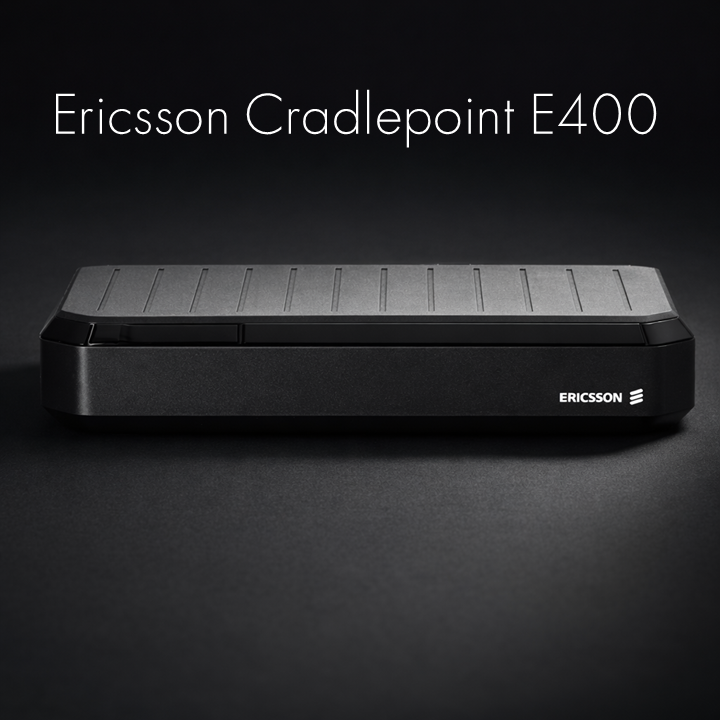
At the center of this shift is a new generation of enterprise cellular routers designed specifically for high-performance wireless WAN deployments. One of the newest additions to this category is the Ericsson Cradlepoint E400, a next-generation routing and security appliance built for modern branch networking environments.
With support for 5G Release 17, Wi-Fi 7, SD-WAN integration, and multi-WAN flexibility, the E400 represents a significant step forward in enterprise edge connectivity.
Overview of the Ericsson Cradlepoint E400 Platform:
The Ericsson Cradlepoint E400 is designed as a wireless WAN edge appliance for enterprise branch locations. Rather than serving as a simple cellular modem, the device functions as a complete networking platform combining routing, wireless connectivity, security, and centralized management.
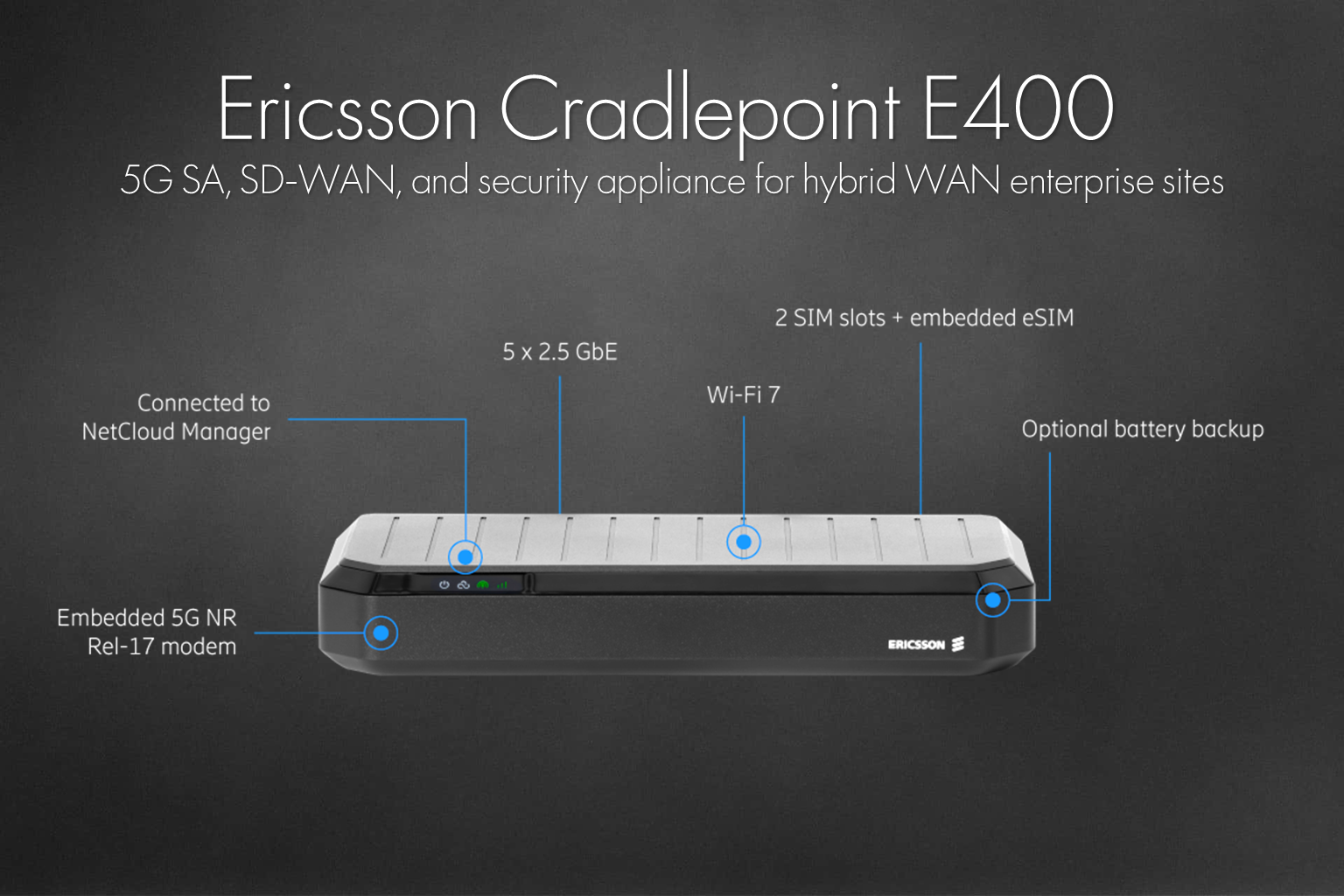
At the core of the platform is a 3GPP Release 17 5G modem, enabling support for both Standalone (SA) and Non-Standalone (NSA) 5G architectures. This allows enterprises to take advantage of emerging cellular network capabilities as carriers continue expanding 5G infrastructure.
The E400 integrates multiple networking technologies into a single device, including:
- Embedded 5G NR cellular connectivity
- Wi-Fi 7 tri-band wireless LAN
- Multi-gigabit Ethernet switching
- SD-WAN functionality
- Integrated network security
Together, these capabilities allow the E400 to serve as the primary connectivity hub for modern enterprise locations.
5G Release 17 Cellular Connectivity:
The Ericsson Cradlepoint E400’s integrated cellular modem supports 3GPP Release 17, one of the most advanced cellular standards currently deployed in enterprise networking hardware.
Release 17 introduces a variety of enhancements that improve enterprise wireless WAN deployments, including improved spectral efficiency, expanded device capabilities, and support for emerging services built on 5G Standalone networks.
One of the most notable features supported by the platform is network slicing, which allows cellular operators to allocate dedicated portions of network resources for specific services or customers. This capability enables more predictable performance and service-level guarantees for enterprise deployments operating in congested environments.
In addition to 5G, the E400 also supports LTE Cat 20 fallback, ensuring connectivity remains available in areas where 5G coverage may still be developing.
Wi-Fi 7 Integration for High-Density LAN Environments:
Beyond its cellular capabilities, the E400 integrates a tri-band Wi-Fi 7 radio, supporting simultaneous operation across the 2.4 GHz, 5 GHz, and 6 GHz frequency bands.
Wi-Fi 7, also known as IEEE 802.11be, is designed to deliver significantly higher throughput and lower latency compared to previous Wi-Fi generations. The E400 supports 2×2 MU-MIMO operation with maximum theoretical throughput exceeding 5.7 Gbps in the 6 GHz band alone.
This makes the platform well suited for environments with high wireless device density, including:
- Retail branch locations
- Healthcare facilities
- Financial services offices
- Remote enterprise locations
By combining cellular WAN and high-capacity Wi-Fi LAN capabilities in a single device, the E400 enables a streamlined “branch-in-a-box” architecture.
Multi-Gigabit Wired Connectivity:
The E400 also supports high-performance wired networking through five 2.5-Gigabit Ethernet ports, which can be configured for LAN or WAN operation depending on deployment requirements.
This multi-gigabit switching capability allows the router to support high-bandwidth applications such as:
- Cloud computing platforms
- Edge analytics systems
- High-definition video streaming
- AI-driven retail and industrial analytics
The combination of multi-gigabit Ethernet and high-speed wireless connectivity allows the E400 to handle demanding enterprise workloads without becoming a network bottleneck.
Hybrid WAN and Wireless-First Architecture:
One of the defining characteristics of the E400 is its ability to operate within hybrid WAN architectures.
The platform can function in several different roles depending on the network design:
- Primary 5G wireless WAN connection
- Failover connectivity for wired broadband circuits
- Hybrid wired and cellular WAN deployment
- Temporary or rapidly deployed connectivity solution
These deployment models allow enterprises to maintain reliable connectivity across geographically distributed locations while maintaining flexibility in network design.
The Role of Antennas in Cellular Router Performance:
While enterprise routers like the E400 incorporate advanced modem technology, the overall performance of a cellular connection is still heavily influenced by the antenna system used in the deployment.
Cellular performance depends on several RF parameters, including:
- Reference Signal Received Power (RSRP)
- Signal-to-Interference-plus-Noise Ratio (SINR)
- Multipath propagation and fading
- Carrier aggregation performance
The E400 supports external cellular antennas through four SMA connectors, enabling improved signal reception and MIMO performance when paired with properly designed antenna systems.
External antenna systems can significantly improve connectivity in environments where the router is deployed indoors, inside metal enclosures, or within buildings that attenuate cellular signals.
For enterprise installations, high-efficiency multi-band antennas help ensure the router can fully utilize modern cellular technologies such as carrier aggregation and multi-antenna MIMO architectures.
See all External Antenna Options for the Ericsson Cradlepoint E400
How to Connect External Antennas to the Ericsson Cradlepoint E400
Typical Deployment Environments:
Routers like the E400 are commonly deployed in a wide variety of enterprise networking environments.
Typical use cases include:
- Retail branch networks
- Financial institutions and ATM networks
- Healthcare facilities and clinics
- Transportation hubs
- Industrial IoT environments
- Utility infrastructure monitoring
These environments often require reliable connectivity even in locations where wired broadband options may be limited or difficult to deploy.
Wireless WAN solutions built around 5G routers provide organizations with the flexibility to deploy secure connectivity virtually anywhere.
Bringing It All Together:
The Ericsson Cradlepoint E400 represents a significant advancement in enterprise wireless WAN technology. By combining 5G Release 17 cellular connectivity, Wi-Fi 7 wireless networking, multi-gigabit Ethernet switching, and integrated SD-WAN functionality, the platform provides a powerful foundation for modern branch networking environments.
As enterprises increasingly adopt wireless-first architectures, the cellular connection becomes a critical component of overall network reliability and performance.
Ensuring that the cellular modem can operate at its full potential requires careful attention to the RF environment, antenna selection, and installation practices.
High-performance antenna systems remain a key element in maximizing throughput, improving signal quality, and delivering the resilient connectivity required for today’s distributed enterprise networks.
For more information about high-performance antenna solutions designed for enterprise cellular routers, visit our site for more information at AGantenna.