
Fixed wireless access has evolved rapidly with the maturation of 5G NR and advanced LTE technologies. As throughput demands increase and spectrum utilization becomes more complex, the gateway device at the edge of the network plays a critical role in overall RF performance.
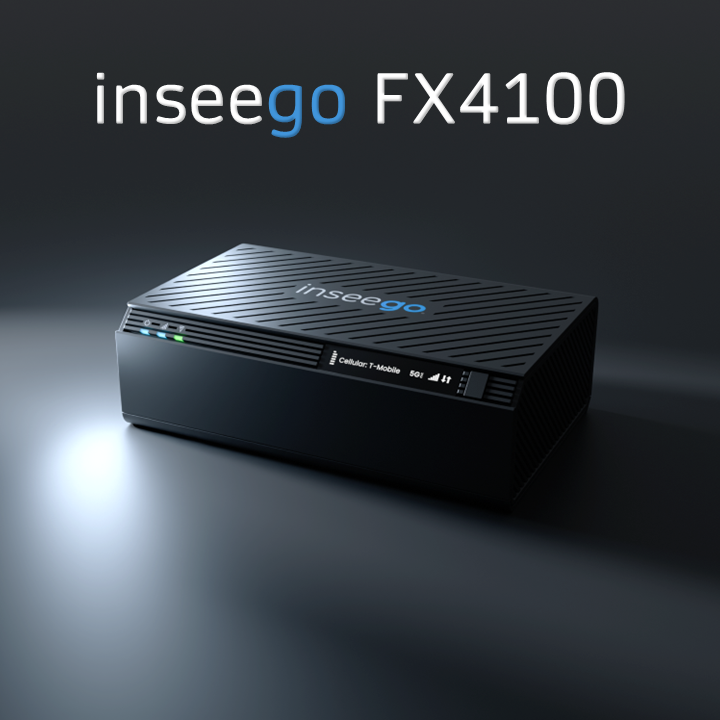
The FX4100 from Inseego represents a modern indoor 5G router platform designed to support high-performance sub-6 GHz deployments. For integrators, network engineers, and RF professionals, understanding its architecture is essential to optimizing system-level performance.
This discussion focuses on the FX4100 from an RF and integration perspective, with particular attention to cellular architecture, MIMO behavior, and external antenna interface considerations.
The Role of the FX4100 in Modern 5G Deployments:
The FX4100 is designed as an indoor 5G fixed wireless router supporting 5G NR in sub-6 GHz bands with LTE fallback capability. It integrates:
- 5G NR sub-6 GHz support
- 4G LTE Cat 20 fallback
- 4x4 MIMO cellular capability
- Integrated dual-band Wi-Fi 7
- Gigabit-class Ethernet connectivity
In fixed wireless environments, this class of router functions as both modem and network core. It manages WAN connectivity, performs carrier aggregation, and distributes traffic to local devices via Ethernet and Wi-Fi.
From an RF engineering perspective, its value lies in how efficiently it can translate available spectrum into usable throughput.
Cellular RF Architecture and MIMO Capability:
5G NR and LTE Support
The FX4100 supports sub-6 GHz 5G NR operation across a wide frequency range. Sub-6 GHz spectrum is critical for balancing coverage and capacity in fixed wireless deployments. These bands provide better propagation characteristics than mmWave while still delivering high throughput when properly engineered.
In addition to 5G NR, LTE Cat 20 fallback ensures continuity in areas where 5G coverage is limited or where dual connectivity is used. Carrier aggregation and advanced modulation schemes allow the device to maximize spectral efficiency when network conditions permit.
4x4 MIMO Implementation
A defining feature of this router class is 4x4 MIMO cellular capability. In ideal network conditions, 4x4 MIMO allows four spatial streams to be transmitted and received simultaneously, increasing peak data rates and improving reliability in multipath environments.
MIMO performance depends on several factors:
- Antenna isolation
- Polarization diversity
- Spatial separation
- Signal correlation characteristics
Even in indoor fixed wireless deployments, multipath can either enhance or degrade performance depending on geometry and antenna configuration. The FX4100’s MIMO architecture is designed to leverage spatial diversity when conditions allow.
Internal vs. External Antenna Interface:
Internal Antenna System
The FX4100 includes an internal multi-element antenna system optimized for general indoor deployment. Internal antennas provide convenience and simplify installation, particularly in strong to moderate signal environments.
However, internal antenna performance is inherently influenced by:
- Router placement
- Building materials
- RF shadowing
- Nearby metallic objects
Indoor attenuation from concrete, metal framing, and energy-efficient glass can significantly reduce effective signal strength.
External Antenna Ports
The FX4100 includes external SMA connectors covering a wide sub-6 GHz frequency range. These ports allow integration with external antenna systems when environmental conditions demand improved link budget or directional control.
When using external antennas, several technical considerations apply:
- The router must properly switch from internal to external RF paths.
- Impedance matching must remain at 50 ohms across the intended band.
- Cable insertion loss must be evaluated against expected gain improvements.
Improper integration can negate theoretical improvements. For example, a 3 dB coaxial loss offsets half of the power improvement provided by antenna gain.
See all External Antenna options for the Inseego FX4100
See Antenna Port Guide for the Inseego FX4100
Wi-Fi 7 Integration and Local Distribution:
Beyond the cellular interface, the FX4100 integrates dual-band Wi-Fi 7 capability. While Wi-Fi performance does not directly impact the RF characteristics of the cellular link, it does affect total throughput demand on the WAN interface.
High-capacity Wi-Fi systems increase concurrent traffic load. In environments with many connected devices, sustained backhaul performance becomes critical. If cellular link quality is marginal, heavy Wi-Fi usage can expose weaknesses in SINR or carrier aggregation performance.
From a system integration standpoint, the router must be evaluated not only for peak throughput but also for sustained performance under load.
Placement and RF Environment Considerations:
The FX4100 is designed for indoor deployment, which introduces environmental variability.
Important RF factors include:
- Building penetration loss
- Distance to serving cell site
- Sector orientation
- Interference from adjacent sectors
- Urban multipath reflections
Even a high-performance 5G router cannot compensate for poor placement. Small changes in location within a structure can result in measurable differences in RSRP and SINR due to reflections and shadowing.
When external antennas are integrated, placement flexibility increases. This allows for improved line of sight and more favorable signal geometry.
Signal Strength vs. Signal Quality:
In fixed wireless deployments, raw signal strength does not tell the full story.
Key metrics include:
- RSRP, Reference Signal Received Power
- SINR, Signal to Interference plus Noise Ratio
- RSRQ, Reference Signal Received Quality
RSRP improvements indicate stronger received signal. However, throughput is more closely tied to SINR and modulation quality.
A system that increases RSRP but captures more interference may show limited performance gains. Conversely, modest increases in signal strength combined with improved interference rejection can produce substantial real-world throughput improvements.
The FX4100 provides management interfaces that allow monitoring of these parameters, enabling iterative optimization during installation.
Coaxial Considerations in External Deployments:
When external antennas are used, coaxial cable becomes part of the RF system.
Important parameters include:
- Frequency-dependent insertion loss
- Shielding effectiveness
- Connector quality
- Bend radius and mechanical stress
At higher sub-6 GHz frequencies, attenuation increases significantly. Long cable runs can reduce effective gain and degrade SINR.
From a system engineering perspective, antenna selection, cable length, and router placement must be evaluated together as a unified RF chain.
Network Management and Optimization:
The FX4100 includes local and remote management capabilities that allow integrators to:
- Monitor signal metrics
- Evaluate band selection and aggregation behavior
- Observe data rate and modulation trends
- Adjust placement and configuration accordingly
Optimization is rarely a single-step process. Iterative adjustment, informed by real signal metrics, is often required to achieve stable and repeatable performance.
Deployment Scenarios:
The FX4100 is well suited for:
- Business continuity and primary WAN replacement
- Remote offices and branch locations
- Construction sites and temporary facilities
- Residential fixed wireless access
- Enterprise failover deployments
In each case, environmental RF conditions determine whether internal antenna performance is sufficient or whether external integration is required.
Bringing It All Together:
The Inseego FX4100 represents a modern 5G fixed wireless router platform engineered for sub-6 GHz performance, 4x4 MIMO capability, and high-capacity local distribution.
For RF professionals, its value lies in:
- Wideband cellular support
- Advanced MIMO architecture
- External antenna interface flexibility
- Real-time signal monitoring capability
As with any RF system, performance is determined by the complete signal chain. Router capability, antenna geometry, coaxial integrity, and environmental conditions all interact to define real-world results.
When properly integrated and optimized, the FX4100 serves as a capable foundation for high-performance 5G fixed wireless deployments in a wide range of commercial and enterprise environments. Talk to an expert today about antenna solutions for the Inseego FX4100 at AGAntenna.