
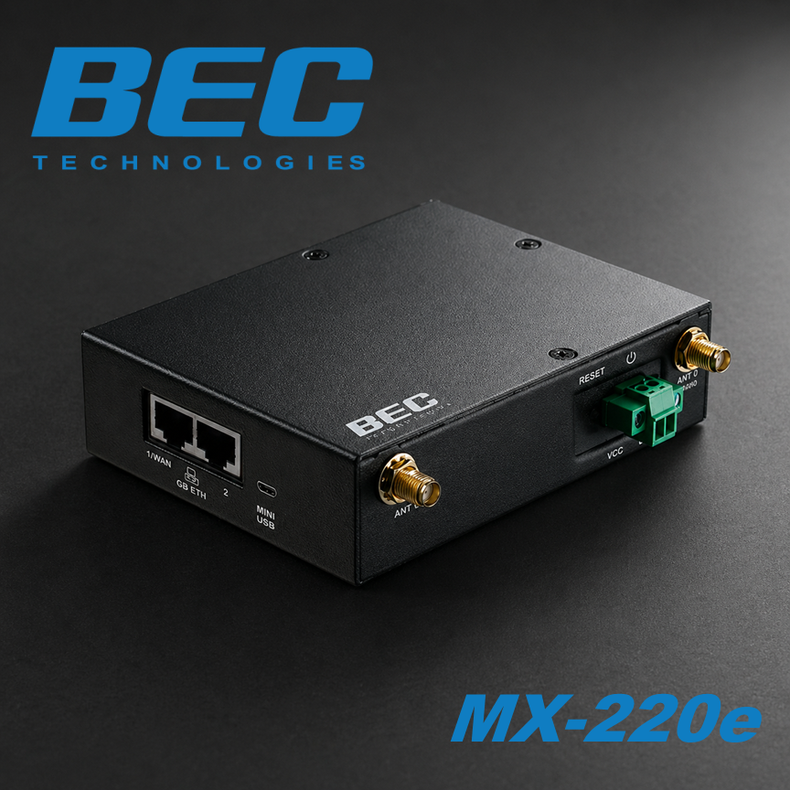
As 5G continues to move deeper into industrial and enterprise environments, the demand for compact, high-performance routing platforms has grown significantly. Many deployments today require more than just connectivity. They require reliability, flexibility, and the ability to operate in constrained or harsh environments without sacrificing performance.
The BEC MX220e is designed to meet these demands. It brings together advanced 5G capabilities, enterprise-grade routing, and a compact industrial form factor that fits where larger platforms cannot.
What is the BEC MX220e?
The BEC MX220e is a 5G industrial router built for IoT, M2M, and enterprise edge applications. It is part of BEC’s MX-220 series, which is designed to deliver scalable, high-performance connectivity across a wide range of deployment scenarios.
At its core, the MX220e is engineered to provide:
- High-speed 5G and LTE connectivity
- Advanced routing and security capabilities
- Flexible deployment in space-constrained environments
This makes it well-suited for distributed networks where reliability and uptime are critical.
Form Factor and Deployment Flexibility
One of the defining characteristics of the BEC MX220e is its compact, industrial design.
Physical and Environmental Design
- Small footprint for installation in enclosures, cabinets, or vehicles
- DIN rail and wall mounting options
- Extended operating temperature range for industrial environments
- Wide DC input range for flexible power integration
Why This Matters
In many edge deployments, space is limited and environmental conditions are not ideal. A router that can be deployed in tight spaces while maintaining stable performance under temperature and power variability is essential for long-term reliability.
5G and LTE Performance Capabilities
5G NR Capabilities
The BEC MX220e supports modern 5G architectures, including:
- Standalone (SA)
- Non-Standalone (NSA)
It operates across sub-6 GHz spectrum and supports carrier aggregation, enabling higher throughput and improved spectral efficiency.
LTE Fallback and Continuity
When 5G is not available, the device seamlessly falls back to LTE:
- LTE Category 19 support
- Multi-carrier aggregation for improved performance
Why This Matters
Real-world networks are dynamic. The ability to transition smoothly between 5G and LTE ensures consistent connectivity across varying coverage conditions.
Spectrum Flexibility and Carrier Compatibility
The BEC MX220e is designed to operate across a broad range of frequency bands, enabling compatibility with multiple carriers and network types.
Key Capabilities
- Support for low-band, mid-band, and sub-6 GHz 5G spectrum
- Compatibility with major U.S. carriers
- Support for private LTE and private 5G deployments
Deployment Advantage
This level of flexibility allows a single hardware platform to be deployed across multiple regions and carrier environments, reducing complexity and simplifying scaling.
Enterprise Networking and Routing Capabilities
Beyond connectivity, the BEC MX220e delivers a full suite of enterprise networking features.
Advanced Routing
- BGP and OSPF dynamic routing protocols
- VLAN segmentation and QoS for traffic prioritization
Security
- Stateful firewall
- VPN support including IPSec and OpenVPN
- Secure tunneling for remote connectivity
Redundancy and Uptime
- Dual SIM failover
- WAN failover and load balancing
- High-availability configurations
These features enable the MX220e to function as a critical component in distributed and mission-critical network architectures.
Edge Intelligence and Remote Management
Modern deployments require visibility and control at scale. The BEC MX220e integrates with centralized management platforms that support:
- Zero-touch provisioning
- Remote configuration and firmware updates
- Real-time monitoring and diagnostics
This reduces operational overhead and allows for efficient large-scale deployments across geographically dispersed networks.
Antenna Architecture and RF Considerations
Cellular Antenna Configuration
The BEC MX220e includes multiple antenna ports to support MIMO operation:
- 4x4 MIMO for mid and high-band performance
- 2x2 MIMO support for low-band
RF Performance Implications
The performance of this router is heavily influenced by the antenna system. Key considerations include:
- Antenna placement relative to the serving cell
- Cable loss and connector quality
- Proper spacing for MIMO efficiency
Why Antenna Design Matters
Even with a high-performance modem, poor RF conditions can limit throughput and reliability. Optimizing the antenna system improves:
- SINR and signal quality
- Carrier aggregation effectiveness
- Overall network stability
See all External Antennas for the BEC MX-220e
See the How to Connect External Antennas Port Guide for the BEC-MX220e
Ideal Use Cases and Deployment Scenarios
The BEC MX220e is well-suited for a wide range of applications:
- Industrial IoT and automation
- Retail and branch failover connectivity
- Smart infrastructure and city deployments
- Energy and utility monitoring
- Mobile and vehicle-based networking
Its compact design and flexible connectivity make it adaptable to both fixed and mobile environments.
Positioning Within the MX-220 Series
Within the MX-220 family, the BEC MX220e is positioned as a compact, versatile solution.
Key Differentiation
- Smaller footprint compared to larger MX-220 models
- Focus on flexible edge deployments
- Ideal for installations where space and power are limited
Selecting the right model depends on application requirements, including physical constraints and network architecture.
Common Deployment Considerations
When deploying the BEC MX220e, several factors should be evaluated:
- Carrier selection and band compatibility
- Antenna type and placement strategy
- Cable selection and loss management
- Environmental conditions and mounting location
- Redundancy requirements for uptime
Addressing these considerations early ensures optimal performance and long-term stability.
Bringing It All Together
The BEC MX220e delivers a compelling combination of compact design, advanced 5G performance, and enterprise-grade networking capabilities.
However, the router is only one part of the overall system. Real-world performance is heavily influenced by RF conditions, antenna design, and installation quality.
Pairing a platform like the MX220e with properly engineered external antennas allows deployments to fully leverage available spectrum, improve signal quality, and maintain consistent connectivity in demanding environments.
For additional insight into antenna solutions designed to complement advanced 5G routers, visit AGAntenna.