
For years, cellular advancements have been defined by higher throughput, more carrier aggregation, and increasingly complex RF architectures. While that approach supports high-bandwidth applications, it often overshoots the needs of real-world IoT deployments.
Most commercial and industrial IoT systems are not limited by data rate. They are constrained by power availability, installation complexity, and long-term reliability. In many cases, traditional 5G hardware introduces unnecessary overhead.
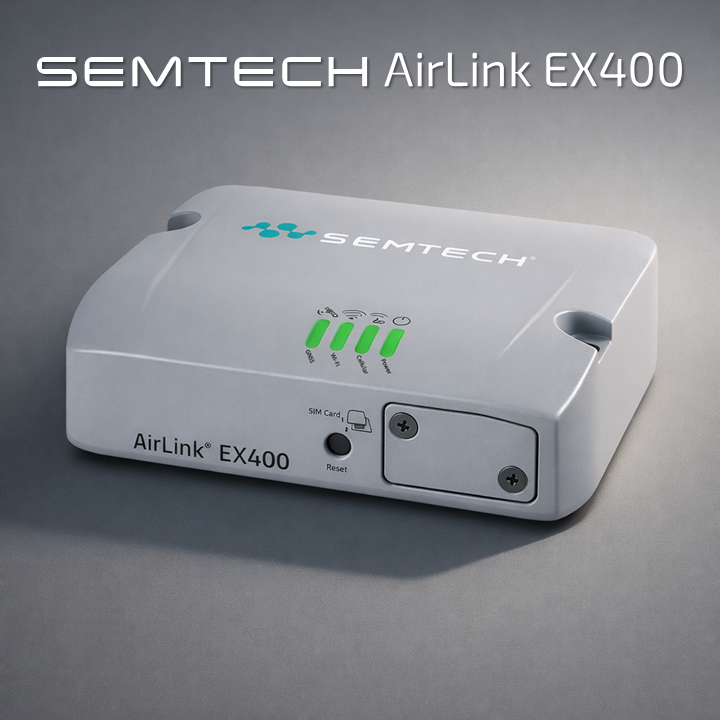
The Semtech Sierra Wireless AirLink EX400 represents a shift in approach. Rather than maximizing performance on paper, it delivers 5G connectivity that is aligned with how IoT networks actually operate.
A Different Class of 5G Router:
The AirLink EX400 is designed for commercial IoT environments where efficiency and stability matter more than peak throughput. It leverages 5G RedCap, introduced in 3GPP Release 17, to reduce complexity at both the RF and system levels.
Instead of the 4x4 MIMO architectures commonly found in traditional 5G routers, the EX400 operates on a 2x2 MIMO design. This reduction in RF chains lowers power consumption, simplifies antenna requirements, and improves deployment consistency. LTE fallback ensures continuity in areas where 5G coverage is still evolving, making the platform viable for long lifecycle deployments.
From an engineering standpoint, this is not a limitation. It is a deliberate optimization. The EX400 is built to match the throughput and latency requirements of IoT systems without introducing unnecessary RF overhead.
Hardware Designed for Practical Deployment:
The EX400 reflects a design philosophy centered on real-world installation. Dual Gigabit Ethernet interfaces provide flexibility for WAN and LAN configurations, while optional Wi-Fi 6 and integrated GNSS support extend its role beyond simple connectivity.
The antenna architecture is notably simplified. With two cellular ports supporting 2x2 MIMO, along with GNSS and optional Wi-Fi connections, the device avoids the complexity of higher-order MIMO systems. This directly reduces cable runs, insertion loss, and the potential for installation variability.
In practice, fewer RF chains mean fewer opportunities for mismatch, imbalance, or excessive loss, all of which can degrade overall system performance.
Power Efficiency as a Design Advantage:
One of the most important characteristics of the EX400 is its power profile. Compared to traditional 5G routers, which often require substantial power budgets, the EX400 operates with significantly lower consumption, particularly at idle.
This opens the door to deployment scenarios that are often difficult to support with conventional 5G hardware. Solar-powered systems, battery-backed installations, and remote sites with limited infrastructure all benefit from a platform that minimizes power demand without sacrificing connectivity.
Lower power consumption also reduces thermal stress, which contributes to long-term reliability in environments where maintenance access may be limited.
Where the EX400 Fits:
The EX400 is best understood as an edge connectivity device for distributed networks. It is well suited for applications such as digital signage, kiosks, EV charging stations, and remote monitoring systems, where consistent connectivity is more important than maximum throughput.
These deployments often operate in constrained environments, whether due to enclosure size, available power, or mounting limitations. In these cases, the EX400 provides a balanced solution that supports modern cellular standards without introducing unnecessary complexity.
Antenna System Implications:
The shift to a 2x2 MIMO architecture has meaningful implications for antenna system design. With fewer antenna elements in play, each one has a greater impact on overall performance.
This places increased importance on proper antenna selection, placement, and installation. Radiation pattern becomes a key consideration, particularly when deciding between omnidirectional coverage and more focused directional gain. Cable loss must also be managed carefully, especially in lower power systems where every dB of loss directly affects link quality.
Equally important is maintaining proper impedance matching. Poor return loss translates into reflected energy, reducing the efficiency of the system and limiting the effectiveness of the available transmit power. In a simplified RF architecture like the EX400, these factors are more pronounced, making attention to antenna design and installation critical.
See all External Antenna Options for the Semtech Sierra Wireless EX400
See the How to Connect External Antenna Guide for the Semtech Sierra Wireless EX400
Positioning Against Traditional 5G Routers:
The EX400 is not intended to compete with high-throughput 5G platforms. Instead, it fills a gap that those devices often overlook.
Traditional 5G routers are designed for maximum performance, which comes with increased power consumption, more complex antenna systems, and higher overall cost. The EX400 takes a different approach by focusing on efficiency and scalability, delivering the performance required for IoT without overengineering the solution.
In many network architectures, it complements higher-end routers by serving as a distributed edge node or a reliable secondary connection.
Bringing It All Together:
The Semtech Sierra Wireless AirLink EX400 reflects a broader shift in how cellular connectivity is being applied. Rather than pursuing peak performance at all costs, it emphasizes efficiency, simplicity, and long-term viability.
By leveraging 5G RedCap, the EX400 delivers a platform that is better aligned with the realities of IoT deployments. It reduces power consumption, simplifies RF design, and enables more flexible installation, all while maintaining access to modern cellular networks.
For many applications, this is not a step down from traditional 5G. It is a more appropriate solution.