
Vehicles are no longer just transportation platforms. In many industries, they have become mobile edge computing nodes, communications hubs, and real-time data platforms. Public safety vehicles stream live video, transit fleets provide passenger connectivity, utility trucks transmit telemetry from field operations, and industrial fleets rely on constant connectivity for operations and logistics.
As these applications expand, the networking requirements placed on mobile infrastructure have increased dramatically. Modern deployments require:
- High-bandwidth 5G connectivity
- Low-latency communications
- Multi-carrier redundancy
- Secure WAN connectivity
- Edge compute capabilities
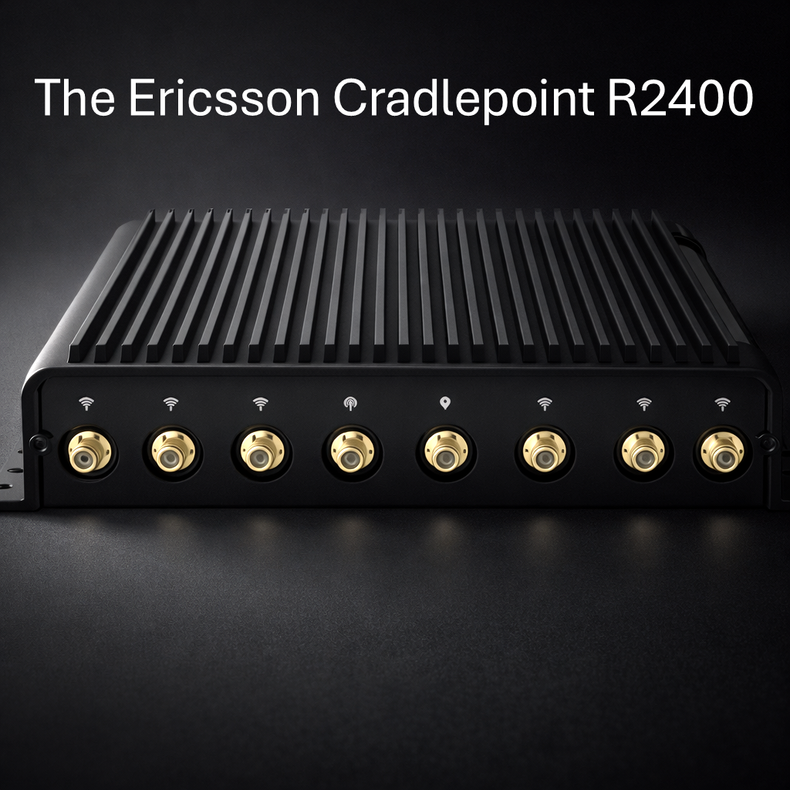
The Ericsson Cradlepoint R2400 was engineered to address exactly these challenges. Designed as a ruggedized in-vehicle 5G router and edge networking platform, the R2400 enables high-performance connectivity in motion while supporting emerging technologies such as edge AI, high-precision positioning, and next-generation Wi-Fi.
Understanding the Ericsson Cradlepoint R2400 Platform:
Overview of the R2400
The Ericsson Cradlepoint R2400 is part of Cradlepoint’s vehicle and mobile networking portfolio, designed specifically for demanding environments where connectivity must remain reliable even while moving across variable coverage zones.
Unlike traditional vehicle routers that primarily serve as cellular gateways, the R2400 is designed as a complete mobile networking platform capable of supporting advanced applications, including:
- Real-time video streaming from mobile cameras
- Connected vehicle infrastructure systems
- Fleet telemetry and diagnostics
- Passenger Wi-Fi services
- Edge computing workloads
The router is engineered to operate in challenging conditions common to mobile deployments, including vibration, temperature fluctuations, and unpredictable RF environments.
Key Architecture and Technology Innovations:
5G Standalone and Advanced Cellular Connectivity
One of the defining characteristics of the R2400 is its support for 5G Standalone (SA) architecture.
While early 5G deployments relied on non-standalone configurations built on LTE infrastructure, standalone 5G networks introduce several significant advantages:
- Lower latency
- Improved network efficiency
- Advanced features such as network slicing
- Greater flexibility for mission-critical applications
These capabilities allow mobile networks to deliver predictable performance for latency-sensitive workloads, such as real-time video analytics or emergency response communications.
For mobile deployments where performance and reliability are essential, 5G SA support positions the R2400 as a platform capable of evolving alongside carrier network upgrades.
Multi-Link Connectivity and Resilient WAN Architecture:
Connectivity interruptions are particularly problematic for vehicles operating in motion. Cellular coverage conditions can change rapidly as vehicles move between towers, network sectors, and geographic environments.
To mitigate these challenges, the R2400 supports multi-link WAN connectivity.
This architecture allows the router to maintain multiple simultaneous network connections across different carriers or technologies. Intelligent path management can dynamically select the optimal connection path based on factors such as:
- Signal quality
- latency
- throughput
- packet loss
By maintaining multiple available WAN paths, the R2400 significantly improves the resilience of mobile connectivity, helping ensure continuous data flow even when primary network paths degrade.
Ultra-Fast Carrier Failover with Dual SIM and Dual Standby:
Carrier redundancy is a critical requirement for many mobile networking deployments. The R2400 incorporates Dual SIM Dual Standby (DSDS) capabilities designed to minimize service interruptions.
In traditional failover scenarios, switching between carriers can take several seconds, during which active sessions may drop. The R2400’s architecture dramatically reduces failover time, enabling near-instant switching between carriers.
This capability is particularly important for:
- Emergency response vehicles
- Remote monitoring systems
- Live video streaming applications
- Fleet management systems that require constant telemetry
The result is a more resilient mobile WAN infrastructure, capable of maintaining connectivity even when individual carrier networks experience disruptions.
Edge Compute and AI-Enabled Networking:
Modern vehicles increasingly rely on onboard processing for applications such as video analytics, sensor fusion, and telemetry analysis.
The R2400 incorporates enhanced edge computing capabilities, enabling the router to support containerized applications and local processing workloads.
By processing data at the network edge, organizations can:
- Reduce latency
- Minimize backhaul bandwidth usage
- Enable real-time decision making
Examples of edge applications supported in vehicle environments include:
- AI-based video recognition systems
- traffic monitoring
- environmental sensing
- real-time incident detection
Edge computing capabilities allow the R2400 to function not just as a router, but as a distributed computing platform integrated directly into mobile infrastructure.
High-Precision Positioning and Navigation:
Many modern fleet applications require location accuracy that exceeds the capabilities of standard GNSS receivers.
The R2400 incorporates advanced positioning technologies, including Real-Time Kinematics (RTK) and dead-reckoning capabilities.
This combination allows the system to maintain highly accurate positioning even in environments where satellite visibility may be partially obstructed, such as:
- urban canyons
- tunnels
- dense industrial environments
These technologies enable centimeter-level positioning accuracy, which is increasingly important for applications such as:
- autonomous vehicle navigation
- precision fleet tracking
- advanced logistics systems
High-Performance In-Vehicle Wi-Fi:
In addition to cellular connectivity, the R2400 includes an integrated high-performance Wi-Fi access point designed to support onboard connectivity requirements.
Modern vehicle deployments often require multiple wireless clients to connect simultaneously, including:
- onboard tablets and mobile computers
- IoT sensors
- surveillance cameras
- passenger devices
With high-throughput Wi-Fi capabilities, the router can support dense wireless environments within vehicles while maintaining reliable connectivity back to the cellular WAN.
Modularity and Future-Proof Networking:
Modular Architecture and Extensible Modem Design
Technology cycles in wireless networking move quickly, and replacing hardware across large fleets can be expensive.
The R2400 addresses this challenge through a modular architecture that supports extensible modem upgrades.
This design allows organizations to upgrade cellular modem capabilities as network technologies evolve without replacing the entire router platform.
The benefits of this approach include:
- longer hardware lifecycle
- improved return on infrastructure investment
- faster adoption of future wireless technologies
For large fleet deployments, this flexibility can significantly reduce long-term infrastructure costs.
Network Management and Security:
Centralized Management with NetCloud
Managing large deployments of mobile routers requires centralized orchestration tools.
The R2400 integrates with Ericsson NetCloud, Cradlepoint’s cloud-based network management platform.
NetCloud provides a range of capabilities including:
- device provisioning
- configuration management
- remote diagnostics
- performance monitoring
- firmware updates
These tools allow organizations to manage entire fleets of mobile routers from a centralized interface, simplifying network operations and reducing administrative overhead.
Deployment Scenarios and Industry Applications:
Where the R2400 Excels
The capabilities of the R2400 make it well suited for a wide range of mobile networking environments.
Public Safety
Emergency vehicles increasingly depend on real-time connectivity for operations such as video streaming, remote database access, and communications with command centers.
Reliable 5G connectivity allows responders to maintain situational awareness while operating in the field.
Mass Transit
Transit authorities deploy vehicle routers to provide passenger Wi-Fi while also supporting internal systems such as ticketing, surveillance, and operational telemetry.
Utilities and Field Operations
Utility companies rely on connected service vehicles for field inspections, equipment monitoring, and remote diagnostics.
Reliable mobile networking enables field teams to transmit operational data directly from the field.
Smart Transportation
Connected vehicle ecosystems depend on constant data exchange between vehicles, infrastructure, and centralized systems.
High-performance vehicle routers serve as the communications backbone for these evolving intelligent transportation systems.
Antenna Considerations for the R2400:
Why Antenna Selection Matters
While advanced router platforms provide the networking intelligence, RF performance ultimately depends on the antenna system deployed with the router.
Vehicle deployments introduce unique RF challenges, including:
- constantly changing signal environments
- vehicle body attenuation
- limited mounting locations
- cable loss from long RF runs
To maximize the performance of a platform like the R2400, antenna systems must support:
- multi-band cellular MIMO configurations
- GNSS reception
- Wi-Fi connectivity
- rugged environmental durability
Proper antenna placement, grounding, and cable selection can significantly impact overall system performance.
See All External Antennas for the Ericsson Cradlepoint R2400
How to Connect External Antennas to the Ericsson Cradlepoint R2400
Bringing It All Together:
The Ericsson Cradlepoint R2400 represents a new generation of mobile networking infrastructure. Rather than functioning solely as a cellular router, it operates as a mobile edge networking platform capable of supporting advanced wireless connectivity, edge computing, and intelligent vehicle systems.
With support for 5G Standalone networks, multi-carrier resilience, edge compute capabilities, and modular hardware architecture, the R2400 provides a foundation for the increasingly connected future of mobile operations.
As fleets, public safety networks, and industrial vehicles continue to evolve toward data-driven operations, platforms like the R2400 will play a central role in enabling reliable connectivity wherever those vehicles operate.