
As enterprise networks continue shifting toward wireless-first architectures, there is increasing demand for compact platforms that can deliver reliable, high-performance connectivity without the footprint of traditional branch infrastructure.
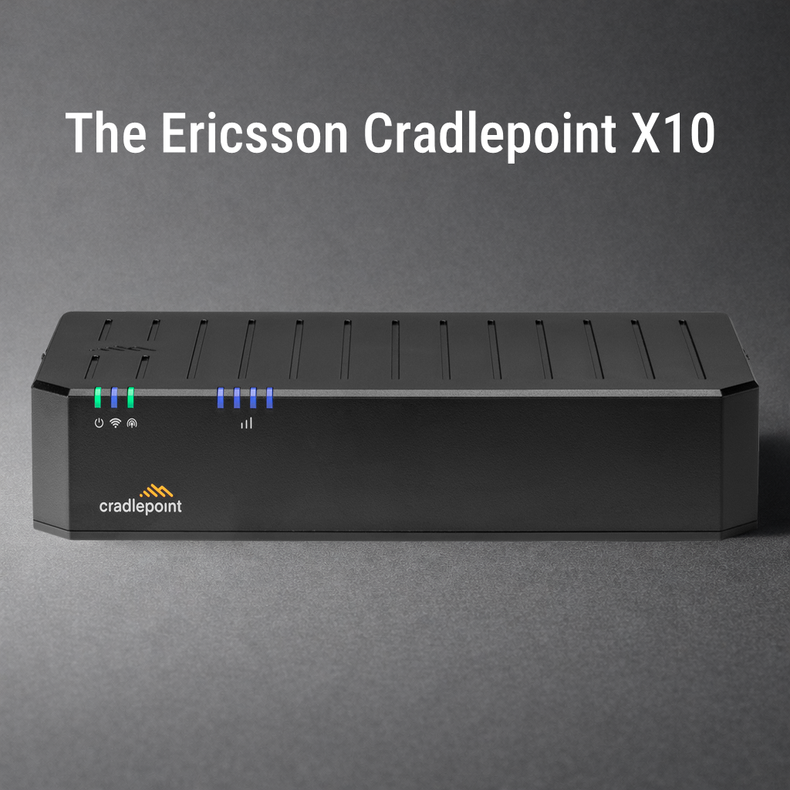
The Ericsson Cradlepoint X10 is designed to meet that need, providing 5G WAN connectivity, integrated local networking, and cloud-based management in a streamlined form factor. For deployments where space, speed, and simplicity matter, the X10 offers a practical entry point into enterprise-grade 5G networking.
What is the Ericsson Cradlepoint X10?:
The X10 is a compact 5G router built for small branch locations, temporary sites, and remote connectivity scenarios. It combines cellular WAN access with integrated LAN distribution, allowing it to function as a complete networking solution in environments where traditional wired infrastructure is unavailable or impractical.
By reducing hardware complexity while maintaining core enterprise features, the X10 enables rapid deployment without sacrificing control or visibility.
Core Hardware and Connectivity Architecture:
5G NR and LTE Capabilities
The X10 supports sub-6 GHz 5G NR with compatibility across both standalone and non-standalone network architectures. This ensures flexibility across carrier deployments while maintaining consistent performance.
LTE fallback provides continuity in areas where 5G coverage is limited, with support for high-category LTE performance enabling strong throughput even outside 5G coverage zones.
From an RF standpoint, this multi-band, multi-mode capability requires antenna systems that can operate efficiently across a wide frequency range while maintaining stable impedance and radiation characteristics.
Cellular Architecture and MIMO Performance:
The X10 leverages 4x4 MIMO for its cellular interface, enabling higher throughput through spatial multiplexing.
Key RF considerations include:
- Maintaining low envelope correlation coefficient between antenna elements
- Ensuring proper antenna spacing and polarization diversity
- Supporting multiple simultaneous data streams without degradation
MIMO performance is directly tied to antenna design and placement, making external antenna systems a critical component in maximizing throughput.
Integrated Wi-Fi for Local Connectivity:
The X10 includes integrated Wi-Fi, allowing it to function as both a WAN gateway and local access point. This simplifies deployments by reducing the need for additional hardware.
However, coexistence between Wi-Fi and cellular radios introduces RF design considerations, particularly in minimizing self-interference and optimizing placement for both systems.
Ethernet and Hybrid WAN Integration:
In addition to wireless connectivity, the X10 includes Ethernet interfaces for wired devices and hybrid WAN configurations.
This enables:
- Cellular as a primary WAN with wired failover
- Wired primary WAN with cellular backup
- Seamless integration into existing network environments
Network Resiliency and Failover:
The X10 supports WAN failover configurations that enhance network reliability. Depending on deployment and configuration, this can include:
- Automatic failover between WAN sources
- Continuous link monitoring
- Policy-based traffic routing
For mission-critical applications, maintaining uptime requires both robust network design and strong RF performance to ensure consistent cellular connectivity.
Cloud Management with NetCloud:
Like other Cradlepoint platforms, the X10 integrates with NetCloud for centralized management.
This provides:
- Zero-touch provisioning
- Remote configuration and monitoring
- Real-time performance visibility
For distributed deployments, this level of control enables consistent policy enforcement and simplifies large-scale network management.
Deployment Flexibility and Use Cases:
Small Branch and Retail
The X10 serves as a primary WAN solution for small locations where wired connectivity is either unavailable or too costly to deploy.
Temporary and Rapid Deployments
Pop-up locations, events, and construction sites benefit from the ability to quickly establish connectivity without waiting for fixed infrastructure.
Remote Workforce Connectivity
The X10 enables enterprise-grade networking in remote environments, extending corporate network capabilities beyond traditional office boundaries.
Antenna Considerations for the X10:
Internal vs External Antennas
While the X10 includes internal Wi-Fi antennas, their performance is inherently limited by enclosure size, placement constraints, and environmental factors.
External antennas provide:
- Higher effective gain
- Improved SINR
- Greater flexibility in positioning relative to the signal source
MIMO Optimization:
Achieving optimal 4x4 MIMO performance requires careful antenna system design.
Critical factors include:
- Spatial separation between elements
- Polarization diversity, often cross-polarized configurations
- Minimizing correlation between signal paths
Improper antenna selection can significantly reduce the benefits of MIMO, limiting throughput and reliability.
Frequency Coverage and Band Alignment:
The X10 operates across a wide range of cellular frequencies, typically spanning from low-band 600 MHz through mid-band spectrum.
Antenna systems must:
- Maintain consistent performance across all relevant bands
- Support current and future carrier deployments
- Avoid narrowband limitations that restrict usability
Deployment-Specific Antenna Strategies:
Indoor Deployments
- Placement near windows or external walls to reduce attenuation
- Use of external antennas to bypass building material losses
Outdoor or Fixed Installations
- Directional antennas to improve link budget and isolate desired signals
Mobile Environments
- Omnidirectional antennas for consistent connectivity during movement
See All External Antennas for the Ericsson Cradlepoint X10
How to Connect External Antennas to the Ericsson Cradlepoint X10
X10 vs Larger Enterprise Routers:
Compared to larger platforms, the X10 offers:
- Reduced size and power requirements
- Simplified deployment
- Lower overall complexity
While it may not include every advanced feature of higher-tier routers, it provides a balanced solution for environments where efficiency and footprint are primary concerns.
X10 vs Traditional Wired WAN:
The X10 enables:
- Faster deployment timelines
- Greater flexibility in network design
- Reduced dependency on fixed infrastructure
However, performance remains dependent on RF conditions, making antenna system optimization a key factor in achieving consistent results.
Where the X10 Fits in the Portfolio:
The X10 is positioned as a compact, entry-to-mid tier 5G router within the broader Cradlepoint portfolio.
It complements larger branch and ruggedized platforms by providing a streamlined solution for smaller or more flexible deployments.
Future-Proofing with 5G:
As 5G networks continue to evolve, the X10 provides a scalable platform capable of adapting to increasing bandwidth demands and expanding coverage.
Its support for modern cellular technologies ensures longevity in a rapidly changing wireless landscape.
Bringing It All Together:
The Ericsson Cradlepoint X10 delivers a compact, efficient approach to enterprise 5G connectivity, combining cellular WAN access, local networking, and cloud-based management into a single platform.
However, the effectiveness of any wireless deployment is ultimately determined by RF performance. Antenna system design plays a critical role in unlocking the full capabilities of the X10, directly influencing signal quality, throughput, and reliability.
By pairing the X10 with a properly engineered antenna solution, deployments can achieve consistent, high-performance connectivity across a wide range of environments.